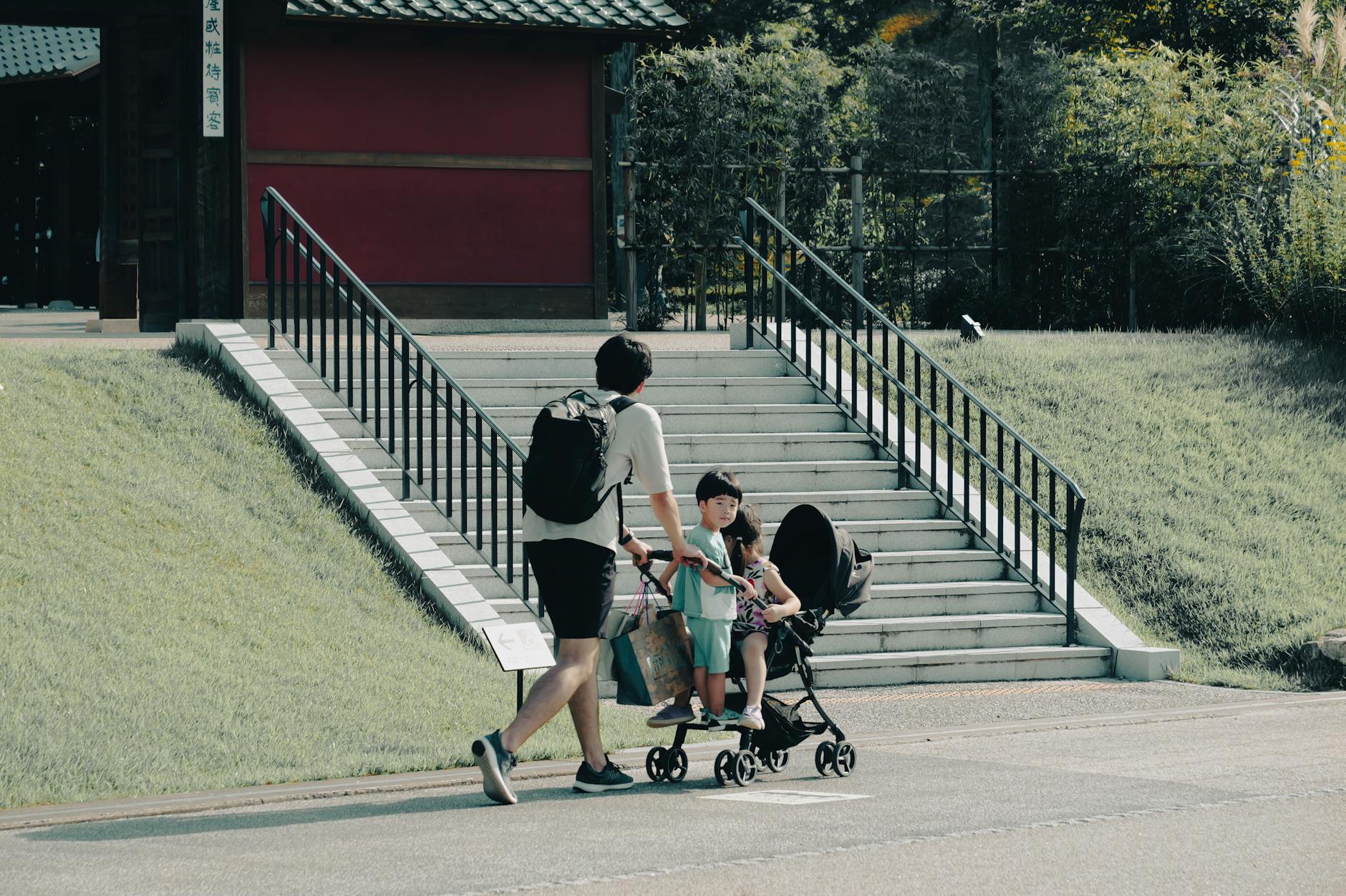
Hour 9 of a 14-hour flight. The cabin lights are dim, the engines are a steady hush, and the toddler is finally asleep — sprawled across two seats with one sock on, a stuffed elephant under her chin, and the in-flight magazine she insisted on holding crumpled in her fist. Nobody is crying. The parents look at each other and silently agree: this is the win. Everything before this moment was just buying time until this moment.
Long-haul flights with kids are not impossible. They are, however, a logistics problem dressed up as a vacation. Here is what actually works.
Seat Strategy: Bulkhead, Bassinet, or Back Row?
The seat map decision happens months before the flight, and it matters more than almost anything else. Three options, three trade-offs.
Bulkhead rows have no seat in front, which gives toddlers a small floor area to fidget in and lets parents stand up without climbing over anyone. The catch: armrests are fixed (no lifting them for a sleep platform), tray tables fold out of the armrest, and carry-ons must go in the overhead during taxi, takeoff, and landing. For infants under ~25 lbs on most carriers, the bulkhead is also where the bassinet attaches.

Bassinet seats are a lifeline on overnight long-hauls if your baby still fits. Lufthansa, Singapore Airlines, Emirates, and most full-service carriers offer them free — but you have to request them at booking, confirm 48 hours out, and accept that they go to the youngest baby on the flight if oversubscribed.
Back row seems counterintuitive but has one underrated advantage: empty middle seats. Load factors are lowest in the last 3-5 rows, which means a family of three sometimes gets a free fourth seat to spread into. The trade-offs are real — engine noise is louder, lavatory traffic is constant, and the recline is often limited. We pick the back row when we are flying as a party of three and the flight is showing less than 80% booked.
Pre-Flight: Sleep Banking and the Snack Bag
The 48 hours before the flight matter as much as the flight itself. If you are flying east (US to Europe, Europe to Asia), shift bedtime 30-60 minutes earlier for two nights. If you are flying west, push it later. Kids’ circadian rhythms are more elastic than adults’ but they need a runway.

The snack bag is its own packing exercise. We aim for ~12 small items per child for a 12-hour flight — twice what you think you need, because boredom-eating is real and a snack interaction buys 4-6 minutes of cooperation. Mix textures (crunchy, chewy, soft), keep sugar low for the back half of the flight, and pack at least two “surprise” snacks the kid hasn’t seen before. Cabin pressure dulls taste perception by ~30%, so flavors that seem bland on the ground (plain crackers, mild cheese) hit fine in the air.
TSA allows formula, breast milk, and toddler drinks in reasonable quantities through US security — declare them at the bin, expect a quick swab test, and budget an extra 5 minutes per child at the checkpoint.
Screen Time on the Plane (Yes, Different Rules Apply)
Whatever your household screen-time rules are, suspend them at 35,000 feet. This is not a moral failing. This is a 12-hour metal tube and your child has nowhere to run off the energy.
That said, structure helps. We use a loose rotation: 45 minutes of screen → 20 minutes of something else (coloring, sticker book, a window walk to the galley) → repeat. Pre-download everything before you leave home, including a buffer of 30-50% more content than you think the flight needs. Seatback screens are unreliable; assume yours will be the one that’s broken.
Noise-cancelling headphones sized for kids are the single highest-leverage purchase. Adult headphones don’t seal properly on small heads, the volume gets cranked to compensate, and now you have a child who can’t hear you over their own audio. Kid-sized over-ear models with a 85dB volume limit solve this in one purchase.

The 4-Hour Bedtime Window (Lights, Pajamas, Stuffed Animal)
The single biggest mental shift for long-haul flights with kids: treat the middle 4-6 hours like bedtime at home, even if local time disagrees. Once meal service ends and the cabin lights dim, run your full bedtime routine in compressed form.
Pajamas (real ones, packed in the carry-on, changed in the lavatory). Teeth (a small toothbrush and a swallow-safe paste or just water). The stuffed animal that comes everywhere. A book read at a whisper. Then the lap blanket, the window shade pulled down, and a deliberate effort to avoid eye contact for the next 20 minutes.
The 4-hour sleep window is the goal, not the guarantee. Some kids hit it. Some hit two hours, wake confused, and need another reset. The point is to give them every cue their body recognizes — darkness, a familiar object, a familiar voice at a familiar pitch — and let biology do what it can.
Melatonin comes up constantly in parent forums for long-haul flights. The American Academy of Pediatrics’ guidance is conservative: short-term, low-dose use for travel can be reasonable for some children, but it should be a pediatrician conversation, not a Reddit decision . Dose, timing, and your specific child’s history matter. Ask your doctor before the trip, not at the gate.
Toddlers vs School-Age vs Tweens (Different Tactics)
A 2-year-old and an 8-year-old are not the same problem.
Toddlers (1-3) need physical engagement. The goal is not to entertain them with content but to get them tired enough to sleep. Walk the aisles every 90 minutes. Let them stand at the window. Pack 2-3 small new toys (a fresh sticker book, a magnetic drawing pad, a finger puppet) and dole them out one at a time. The novelty is the entertainment, not the toy itself.
School-age (4-9) can handle longer content blocks and are old enough to negotiate. Set expectations on the ground: “We’ll watch one movie, then have dinner, then read for a while, then it’s sleep time.” Kids this age respond well to a visible plan and badly to surprises.
Tweens (10-13) mostly want to be left alone with their device and a window seat. Your job shrinks to logistics: water reminders, snack handoffs, and making sure they actually sleep instead of stealth-watching content under the blanket.
Gear That Earns Its Weight
Carry-on real estate is finite. Every item has to justify its volume.

- Kid-sized noise-cancelling headphones with volume limiting (one per child).
- Inflatable foot rest or seat extender (turns a regular economy seat into a flat-ish surface for kids under ~50 inches; check airline policy — some carriers ban them on safety grounds).
- Refillable water bottles (one per person, filled after security).
- Compact stroller that gate-checks (umbrella style, under 15 lbs).
- Change of clothes per child in the carry-on, plus one spare shirt for whichever parent is on duty.
- Wet bag for the inevitable spill or accident.
- A small first-aid kit with kid-dose acetaminophen, bandaids, saline drops, and any prescription meds in original labeled containers.
- Packing cubes so the carry-on isn’t a single chaotic pile by hour six.
The packing cubes feel like overkill until the first time you need to find a specific pacifier at 2am cabin time without unpacking everything onto a sleeping toddler.
FAQs
Should I buy a seat for an under-2?
If your budget allows it, yes — especially on flights over 8 hours. A car seat in its own seat is the FAA’s recommended way to fly with an infant or toddler, and a child who can lie flat will sleep dramatically better than one held in a parent’s lap. Many airlines offer reduced “infant in own seat” fares; ask when booking.
Are airline bassinets reliable?
Mostly yes on full-service long-haul carriers (Emirates, Singapore, Lufthansa, Qantas, ANA), with two caveats: weight and length limits vary by airline (typically 20-25 lbs and 26-28 inches), and assignment is not guaranteed until boarding. Request at booking, confirm 48 hours out, and have a backup plan.
Is melatonin safe for kids on flights?
This is a pediatrician question, not an internet question. The American Academy of Pediatrics’ guidance is that short-term, low-dose melatonin can be reasonable for some children in some travel scenarios — but dose, timing, and your child’s specific health history matter . Ask your doctor before the trip.
Window or aisle for kids?
Window for toddlers and young kids — the view is a built-in distraction, and they can lean against the wall to sleep. Aisle for tweens who want bathroom access on their own terms. The middle seat is for the parent on duty.
What about ear pressure on descent?
For infants, breastfeeding or a bottle during descent helps. For toddlers, a snack or drink works. For older kids, gum or a “big yawn” reminder. Pediatricians sometimes recommend a dose of saline nasal spray before descent if your child has congestion .
Sources
- American Academy of Pediatrics — Flying With Baby
- FAA — Flying With Children
- TSA — Traveling With Children
- CDC — Travel With Children
- AAP — Melatonin and Children’s Sleep
- FAA — Child Safety Restraint Systems
Hero photo: see public/images/blog/family-travel-long-haul-with-kids-hero.json. Inline photos: see docs/image-licenses/family-travel-long-haul-with-kids.md.
Heads up! Some links on this page are affiliate links. We may earn a small commission at no extra cost to you. This helps us keep Traveloonie running and free for everyone.
Reviewed by Traveloonie Team, last updated 2026-06-02.