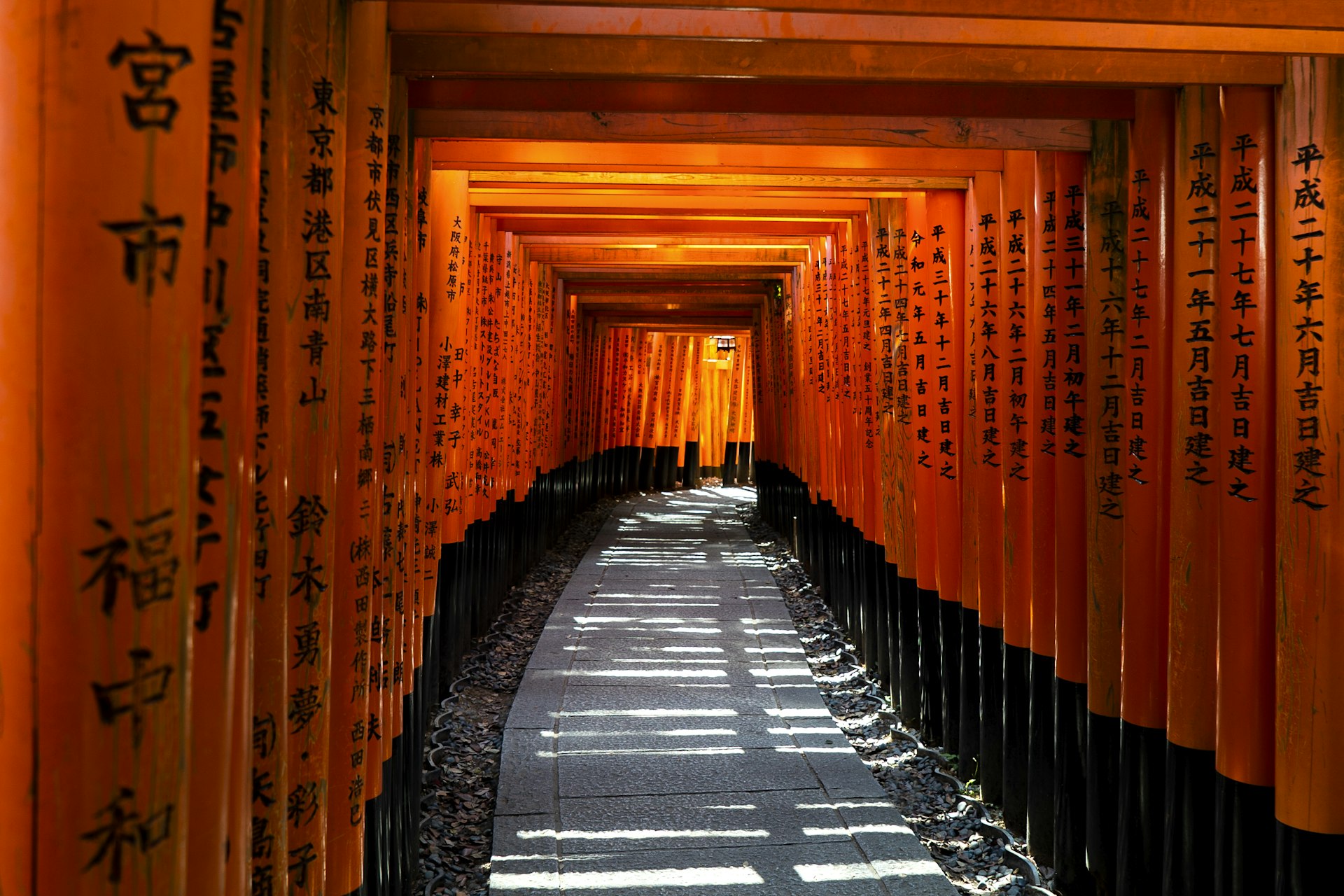
The first time I walked through the lower torii at Fushimi Inari, it was 5:47 a.m. and the only other person on the mountain was an older man sweeping the stone steps with a bamboo broom. By 8 a.m. that path is shoulder-to-shoulder with selfie sticks. By 6 a.m. it is yours. That single dawn hike is the whole argument for this itinerary: Kansai rewards travelers who plan around timing, not just sights.
The Kansai Loop at a Glance
Kansai is the old heart of Japan — Kyoto for temples, Osaka for food, Nara for the deer that will absolutely steal your map. The smart play for five days is to base yourself in Kyoto the entire time. Kyoto Station puts you 14 minutes from Osaka on the JR Kyoto Line and 45 minutes from Nara on the JR Nara Line. You unpack once, you sleep in a quieter city, and you commute toward Osaka’s neon energy instead of trying to escape it at midnight.
I like staying in the Shimogyo / Kyoto Station area for the rail access, or Higashiyama if you want to step out of your ryokan into temple territory. Avoid Gion for sleeping — it’s gorgeous to walk through, but the alleys go quiet by 10 p.m. and you’ll wish you had a konbini downstairs.
Day 1-2: Kyoto Eastern Temples & Gion
The eastern foothills (Higashiyama) hold the postcard Kyoto: Kiyomizu-dera’s wooden stage jutting over the cedars, Yasaka Shrine’s lantern-lit gate, and the slate-paved lanes of Sannenzaka and Ninenzaka climbing between them.
My loop for Day 1: start at Kiyomizu-dera before 8 a.m., walk down through Sannenzaka while the matcha shops are still raising shutters, cut north through Maruyama Park to Yasaka, and finish at Chion-in’s thunderous main gate. That’s a half-day on foot, no bus required.
Day 2 belongs to Fushimi Inari at sunrise. Take the JR Nara Line two stops south from Kyoto Station — five minutes, runs constantly. Hike to the Yotsutsuji intersection halfway up the mountain (about 30-40 minutes of climbing); the crowds thin dramatically past the first big photo cluster, and the city view from Yotsutsuji is the payoff most day-trippers never see. Afternoon: Ginkaku-ji (the Silver Pavilion) and a slow walk down the Philosopher’s Path, a canal-side lane lined with cherry trees that’s just as good in non-bloom months for the moss and the cats.
For dinner, wander Pontocho Alley — a narrow lantern-lit corridor of yakitori counters and kaiseki rooms running parallel to the Kamo River. Sit by the river afterward; locals do it nightly and nobody is in a hurry.

Day 3: Arashiyama & a Quiet Afternoon
The Arashiyama bamboo grove is on every Kyoto list for a reason and against you for the same one — it’s small, and it gets packed. Be there by 8 a.m. or skip it. The grove itself is a 10-minute walk; the real reward is sticking around for Tenryu-ji (UNESCO-listed Zen garden right at the grove’s entrance) and Okochi-Sanso Villa, a former silent-film actor’s hillside garden that costs about 1,000 yen and includes a matcha set with the view.

Cross the Togetsukyo Bridge and rent a rowboat on the Hozugawa if the weather is right, or ride the Sagano Scenic Railway upriver — open-window vintage train, 25 minutes, ridiculously photogenic in autumn. Back in central Kyoto by late afternoon, save energy for a long bath at your ryokan or hotel. Day 4 is going to be a lot of walking.
Day 4: Nara Day-Trip (Deer, Todai-ji, Detour)
Nara is 45 minutes south of Kyoto Station on the JR Nara Line (rapid service; covered by JR Pass and the Kansai Area Pass). Buy shika senbei (deer crackers, sold by licensed vendors around Nara Park for about 200 yen a stack) and accept that you will be mugged by polite ungulates within 90 seconds.

The non-negotiables: Todai-ji’s Great Buddha Hall (one of the largest wooden buildings on Earth, housing a 15-meter bronze Buddha), Kasuga Taisha’s 3,000 stone and bronze lanterns winding up the wooded approach, and the moss-covered ruins of Mount Wakakusa’s lower trail if your legs are still cooperating. Skip the bus — everything is walkable from Kintetsu-Nara Station in under 25 minutes, and the walk is half the charm.
My contrarian detour: if you have a JR Pass, ride three extra stops to Horyu-ji on the way back — the world’s oldest surviving wooden buildings, almost no crowds, and a temple compound that feels exactly as it would have in the 7th century. Most itineraries miss it. Most itineraries are wrong.
Day 5: Osaka Food Crawl (Dotonbori, Kuromon)
Osaka is loud, neon, and run on its stomach. The city’s unofficial motto is kuidaore — “eat yourself bankrupt” — and you should take it as a personal challenge.
Train into Namba Station (14 minutes from Kyoto Station via JR Kyoto Line + transfer at Osaka Station, or use the through-running Hankyu/Keihan if your hotel is closer to those lines). Start the day at Kuromon Ichiba Market — a 600-meter covered arcade selling fatty tuna sashimi, fresh oysters, A5 wagyu skewers, and grilled scallops in the half-shell. Eat standing up. Eat everything.

Walk north toward Dotonbori. This is the canal-side street with the giant mechanical crab and the Glico running-man sign. Required eating: takoyaki (octopus balls), okonomiyaki (savory cabbage pancake), and kushikatsu (skewered fried everything; the rule at the old joints in Shinsekai is no double-dipping in the communal sauce — they will yell at you, kindly). End at the Hozenji Yokocho alley for one last quiet drink in a stone-paved lane that feels four centuries older than the LED chaos one block over.
If you have an extra hour, Osaka Castle’s outer moat at golden hour is the cleanest skyline shot in the city. The keep itself is a concrete reconstruction — admire it from the bridge and save your legs.
When to Go & What to Pack
📅 Climate by month
- Jan8.2°53.6mm
- Feb9.1°64.8mm
- Mar13.6°114.3mm
- Apr18.8°155mm
- May23.3°182.9mm
- Jun26.7°253.9mm
- Jul30.8°247.6mm
- Aug32.4°182.6mm
- Sep28.4°192.2mm
- Oct21.9°190.4mm
- Nov16.3°71mm
- Dec10.6°56.7mm
30-year climate normals (1991–2020) · Open-Meteo / ECMWF IFS
Kansai has four genuinely distinct seasons. Late March to early April is cherry-blossom peak — magical, mobbed, and expensive. Mid-November is autumn-leaf peak at temples like Tofuku-ji and Eikan-do — arguably more beautiful than the cherries, and slightly less insane on hotel pricing. Late May and early June (right now, as I write this) is the sleeper pick: irises blooming, no peak surcharges, weather still pre-monsoon.
Avoid mid-July through August unless you love 35°C and 80% humidity. The temples don’t have air conditioning. The cobblestones radiate heat. Your shoes will not survive.
Pack: a foldable umbrella (rain shows up year-round), slip-on shoes you can take off 14 times a day at temple entrances, cash (Japan is more card-friendly than it used to be but small temples and food stalls are still cash-only), and a small fabric shopping bag — stores charge a few yen for plastic and konbini bags are flimsy.
FAQs
Should I base in Kyoto or Osaka?
Kyoto, for five days. You’ll do at least one long Kyoto sightseeing day with an early start, and the city is quieter at night. Osaka is a fantastic day-trip from Kyoto, not the other way around — the late-night Dotonbori energy is great in 4-hour doses, not as a daily commute back to a temple at 7 a.m.
Is the JR Kansai Pass worth it for 5 days?
For this itinerary, probably yes. The JR Kansai Area Pass (5-day version) covers Kyoto-Osaka-Nara JR commutes and the Haruka airport express from KIX, and pays for itself if you do the airport run plus Nara plus a couple of Osaka trips. If you’re skipping the airport express or staying inside Kyoto more, individual IC card fares (ICOCA or Suica) are cheaper and more flexible.
How early do I need to arrive at Fushimi Inari to beat the crowds?
Be at the lower torii by 6:30 a.m. for a genuinely empty experience up to Yotsutsuji. By 8 a.m. tour groups arrive. By 10 a.m. the lower paths are a slow shuffle. The shrine itself is open 24/7 — there’s no gate, no ticket — so nothing stops you from going even earlier.
Can I do this with kids?
Yes, with two adjustments: cut the dawn Fushimi Inari to a 9 a.m. visit (kids will not forgive 5:30 a.m.), and make Nara your second day instead of your fourth — the deer are unbeatable kid currency and will earn you patience for one more temple day. Skip the kushikatsu communal-sauce rule confrontation; order individual portions.
Sources
- Kyoto City Official Travel Guide — Kyoto Convention & Visitors Bureau
- Osaka Info — Osaka Convention & Tourism Bureau
- Nara Park & Deer Information — Nara Visitors Bureau
- Wikivoyage: Kansai
- JR West — Kansai Area Pass
- UNESCO World Heritage: Historic Monuments of Ancient Kyoto
- UNESCO World Heritage: Historic Monuments of Ancient Nara
Hero photo: see public/images/blog/kyoto-osaka-nara-5-days-hero.json. Inline photos: see docs/image-licenses/kyoto-osaka-nara-5-days.md.
Heads up! Some links on this page are affiliate links. We may earn a small commission at no extra cost to you. This helps us keep Traveloonie running and free for everyone.
Reviewed by Vincent Pham, last updated 2026-05-25.