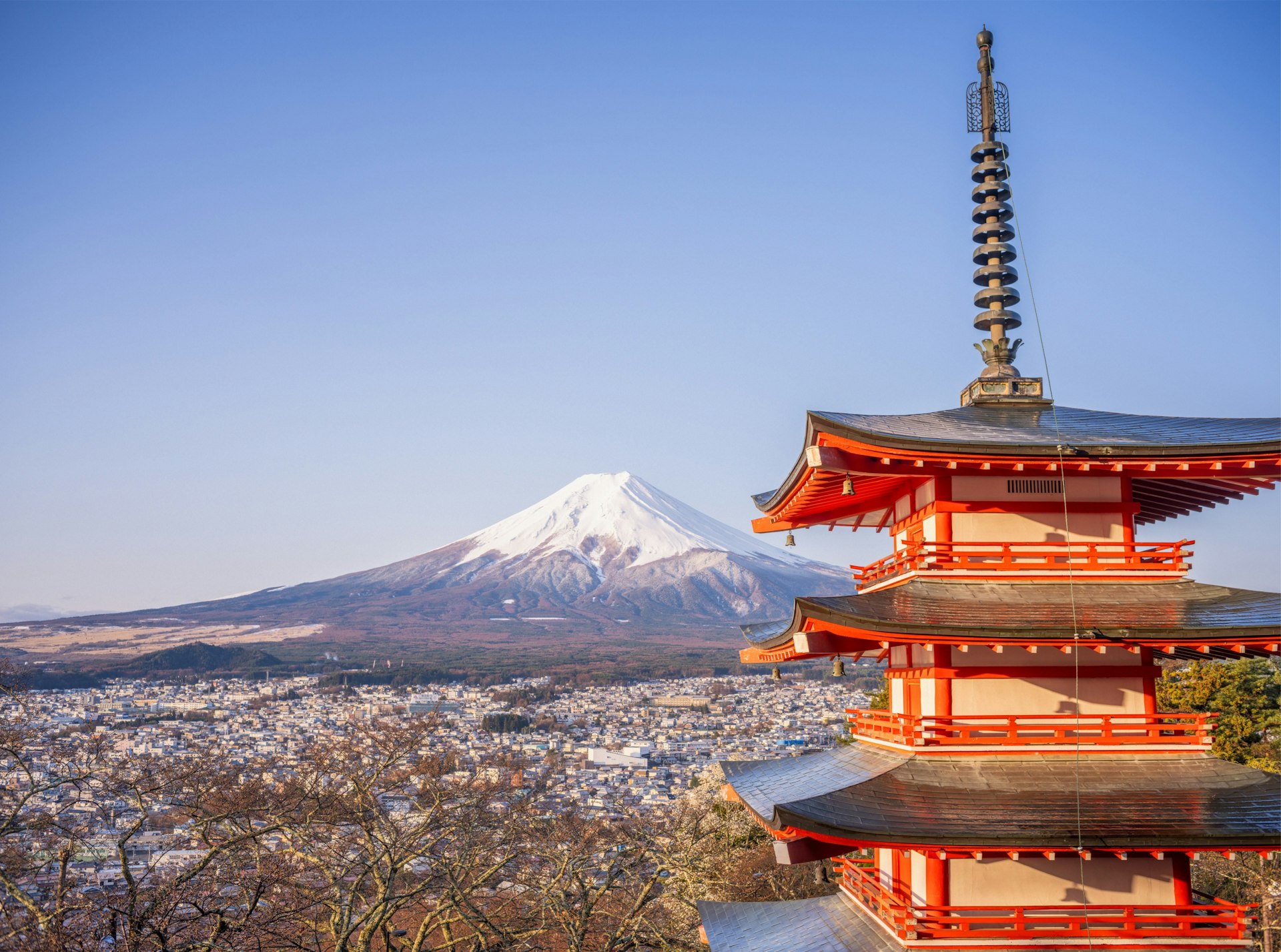
You wait. The bus pulls into a parking lot ringed with cedars, the sky is the colour of wet concrete, and the famous cone — the one printed on every poster, every yen note, every souvenir tea towel — is nowhere. Then a seam opens in the clouds. White shoulders, then a flat snow-streaked summit, then the whole symmetrical bulk of Mount Fuji, hanging over Lake Kawaguchi like a stage set someone wheeled in while you weren’t looking. That moment is why you came. The rest of this guide is how to give yourself the best odds of getting it.
The Real Question: Day-Trip or Overnight?
A day-trip from Tokyo to the Fuji Five Lakes region is genuinely doable. Two hours each way by bus, four to five hours on the ground, back in Shinjuku for dinner. It works. But if you only give Fuji a single afternoon and the clouds don’t cooperate, you go home with photos of a grey wall.
An overnight in Kawaguchiko changes the maths. You get a sunset attempt, a sunrise attempt, and a mid-morning attempt — three rolls of the dice instead of one. Ryokan with onsen run a wide price band, but even the modest ones face the lake and serve a kaiseki dinner that’s an event in itself. If Fuji visibility matters to you more than ticking a box, stay the night.
Day-trip if: you have a tight Tokyo itinerary, you’re flexible about weather, or you’re visiting in winter when skies are clearest. Overnight if: you want the sunrise reflection shot, you’re visiting in summer when clouds build by mid-morning, or you want to actually slow down.

The Bus from Shinjuku (Cheapest)
The Keio and Fujikyu highway bus from Shinjuku Expressway Bus Terminal (Busta Shinjuku) to Kawaguchiko Station is the workhorse route. Around two hours, reserved seating, leaves roughly every 30–60 minutes through the day. One-way fares hover in the budget range — well under the train option . Book ahead through the Highway Bus website or Fujikyu’s portal, especially on weekends and during sakura or autumn leaf season when seats sell out days in advance.
The bus drops you right at Kawaguchiko Station, which is the hub for the area’s sightseeing loop bus (Red Line, Green Line, Blue Line) — your single ticket to Chureito Pagoda, the lakeside viewpoints, and Oishi Park. Buy the two-day Fuji loop pass at the station kiosk if you’re staying overnight; it pays for itself in three rides.
Tip: sit on the right side of the bus going out from Shinjuku. On a clear day Fuji appears about 90 minutes into the trip and stays in view all the way to Kawaguchiko. Left side coming back gives you the same view in reverse.
The Train via Kawaguchiko (Most Comfortable)
The train route is JR Chuo Line from Shinjuku to Otsuki, then transfer to the Fujikyuko Line for the final stretch to Kawaguchiko. Limited express services (Fuji Excursion) run direct from Shinjuku to Kawaguchiko a few times a day — no transfer, around two hours, panoramic windows.
The JR Pass covers the Chuo Line portion but does not cover the Fujikyuko Line, which is a private railway. You’ll pay the Otsuki–Kawaguchiko leg separately . For most travellers this means the train is meaningfully more expensive than the bus and only marginally faster. The exception is the Fuji Excursion service, which is genuinely scenic and worth the upcharge if you’re a train person.
If you’re already moving around Japan on a JR Pass, the calculation shifts — the Chuo Line leg is “free” and you’re only paying the short final segment. Otherwise, the bus wins on value.

Best Viewpoints: Chureito Pagoda, Lake Kawaguchi, Oishi Park
Chureito Pagoda is the photograph. Five-storey vermilion pagoda on a hillside above Fujiyoshida, Fuji rising behind it across the valley. Get off at Shimo-Yoshida Station on the Fujikyuko Line (one stop before Kawaguchiko), then climb 400 steps. In April the foreground fills with cherry blossom; in November it’s red maples. Arrive before 9am or after 3pm to dodge the worst of the crowds and get usable light.
Lake Kawaguchi north shore is the classic mirror-reflection composition. Walk or cycle the path from Oishi Park west along the shoreline. Mornings are calmer; by afternoon the wind ripples the surface and the reflection breaks up. Oishi Park itself has lavender in July, kochia bushes turning crimson in October, and a clean shoreline view that’s wheelchair-accessible from the parking lot.
Lake Yamanaka and Lake Saiko are less photographed and noticeably quieter. If your main view from Kawaguchiko is socked in, hop the sightseeing bus over — sometimes the cloud layer breaks just a few kilometres away.
When Fuji Actually Shows Itself
Mount Fuji is famously shy. The summit is wreathed in cloud more than half the year on average. Visibility is best in winter (December–February) when cold dry air pushes haze south — clear-sky rates run high, snow cover is photogenic, but the air is cold and some seasonal viewpoints close. Spring (March–April) is hit-and-miss but rewards you with cherry blossom foregrounds when it lands. Summer (June–August) is the worst for Fuji-spotting — humid haze, afternoon cloud build-up, monsoon-fed mornings — though it’s the only time you can actually climb the mountain. Autumn (October–November) is the sweet spot for many travellers: stable weather, red maples at Chureito, manageable crowds.
📅 Climate by month
- Jan9.2°52.1mm
- Feb10.5°56mm
- Mar14.4°141.1mm
- Apr18.9°132.5mm
- May23.1°154mm
- Jun26.3°196.4mm
- Jul30.4°173.4mm
- Aug31.8°142.2mm
- Sep27.8°208.8mm
- Oct21.6°197mm
- Nov16.7°87.2mm
- Dec11.5°51mm
30-year climate normals (1991–2020) · Open-Meteo / ECMWF IFS
The Tokyo climate strip above tracks what you’ll experience on the city side of the trip. For Kawaguchiko itself, expect temperatures 5–8°C cooler year-round and noticeably more rain in June.

Hakone vs Fuji Five Lakes
Hakone is the other “see Fuji from near Tokyo” option, and it’s a fundamentally different experience. Hakone is a hot-spring resort town wrapped around a volcanic caldera — ropeway over sulphur vents, pirate ship on Lake Ashi, an open-air sculpture museum, and Fuji visible across the water on clear days. It’s more about Hakone itself than about Fuji specifically.
The Fuji Five Lakes (Kawaguchiko and its neighbours) put Fuji squarely centre-stage. Closer, larger in frame, more shoreline angles. Less polished as a resort destination but better as a Fuji destination.
If you have one day and want Fuji-the-mountain: go to Kawaguchiko. If you have one day and want a Japanese hot-spring-town vibe with Fuji as backdrop: go to Hakone. If you have two days: do both, sleeping in either Hakone or Kawaguchiko on the connecting night.

Language and Logistics
English signage is good at Kawaguchiko Station, the major viewpoints, and the sightseeing bus. It thins out fast at smaller ryokan, family-run soba shops, and the rural bus stops you’ll use if you wander off the main loop. Have a translation tool on your phone before you leave Tokyo — it’s the difference between a smooth check-in and a confused twenty minutes at the reception desk.
A few other practical notes: cash still matters in this region (many ryokan and small restaurants don’t take cards), bring layers even in summer because the altitude bites at sunrise, and download offline maps because mobile coverage drops in pockets along the lakeshore.
FAQs
What month has the best Fuji visibility?
Statistically, December through February have the highest clear-summit rates — cold dry continental air pushes haze away and the snow cap is at its most photogenic. November and March are close runners-up. Summer months (June–August) have the worst visibility because of haze and afternoon cloud build-up.
Can I climb Mount Fuji on a day-trip?
Technically yes, but it’s brutal. The official climbing season is short — early July to early September — and the standard route is an overnight climb starting late afternoon, sleeping briefly at a mountain hut, and summiting for sunrise. A “day-trip” climb means starting before dawn from the fifth station and racing the weather. Most climbers stay at least one night on the mountain.
Is the JR Pass valid to Kawaguchiko?
Partially. The JR Pass covers the Chuo Line from Tokyo to Otsuki, but the final leg on the Fujikyuko Line is a private railway and not covered . The direct Fuji Excursion limited express runs over both networks; the Otsuki–Kawaguchiko portion still requires a separate ticket even with a JR Pass.
Is Hakone or Kawaguchiko better?
For Fuji photographs and Fuji-centric experiences: Kawaguchiko. For a fuller “Japanese resort town” day with onsen, ropeway, lake cruise, and Fuji as one element among many: Hakone. They’re complementary, not competitive — pick based on whether the mountain or the town is your priority.
How early should I book accommodation?
Sakura week (early April) and the autumn leaf peak (mid-November) sell out lakefront ryokan months ahead. Weekends in any month go quickly. For midweek visits outside peak seasons, two to three weeks is usually enough lead time.
Sources
- Fujikyu Railway — Kawaguchiko Line & timetables
- Highway Bus — Shinjuku to Kawaguchiko reservations
- Hakone Official Tourism Information
- Fujisan World Heritage Centre, Yamanashi Prefecture
- Wikivoyage — Mount Fuji
- Japan National Tourism Organization — Mt. Fuji area
- Fuji Five Lakes Sightseeing Bus loop information
Hero photo: see public/images/blog/mount-fuji-day-trip-tokyo-hero.json. Inline photos: see docs/image-licenses/mount-fuji-day-trip-tokyo.md.
Heads up! Some links on this page are affiliate links. We may earn a small commission at no extra cost to you. This helps us keep Traveloonie running and free for everyone.
Reviewed by Traveloonie Team, last updated 2026-05-26.