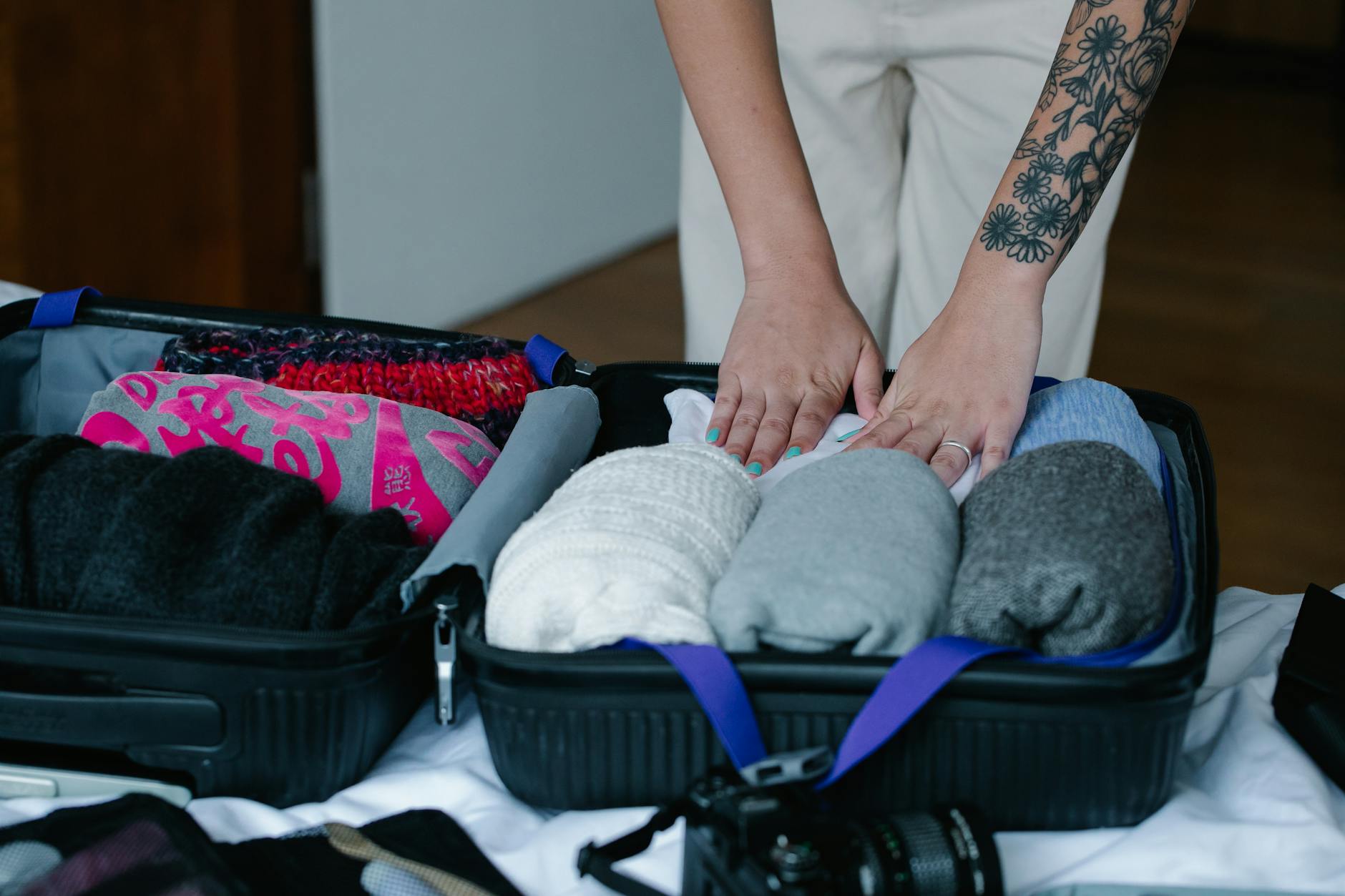
The best part of carry-on-only travel is not the money saved on bag fees. It is watching the baggage carousel start spinning while you walk straight past it toward the taxi stand. Two weeks, three climates, one bag that fits the overhead bin on every airline that matters. The list below is what we actually pack — tested across temple mornings, mountain afternoons, and the occasional rooftop dinner.
The Carry-On Math (Bag Size, Weight Limits Across Airlines)
Carry-on rules are not standardized. The IATA “recommended” size is 55 x 35 x 22 cm, but every airline writes its own rule, and budget carriers (Ryanair, Wizz, AirAsia, Scoot) enforce them with sizers at the gate. The practical sweet spot is a bag at or under 40 liters and roughly 45 x 35 x 20 cm — small enough to satisfy a Ryanair “small bag” allowance with the strap off, large enough for two weeks of clothing.
Weight is the second trap. Most full-service airlines allow 7-10 kg cabin baggage. Hit 8 kg as your personal ceiling and you have margin for one souvenir, a bottle of water, and the occasional gate-side sweater stuff. Weigh the loaded bag at home on a luggage scale before you trust it.
A short hierarchy that has held up across hundreds of flights:
- Carry-on backpack or rolling case (35-40L, soft-sided beats hard-sided for stuffability)
- Personal item (a packable daypack that lives flat inside the main bag on travel days)
- Whatever you wear on the plane (always the bulkiest shoes and the warmest layer)

Clothing: The Capsule Approach (Merino, Layers, One Nice Outfit)
Two weeks of clothing in a carry-on works because of two ideas: a tight color palette (everything mixes) and fabrics that re-wear without smelling. Merino wool is the unfair advantage here — a 150-200 gsm merino t-shirt can go three to four wears between washes, dries overnight, and does not telegraph “tourist.”
The capsule below has covered Tokyo in autumn, Bali in monsoon shoulder season, and a wedding-rehearsal dinner in Lisbon without anyone noticing the repeats.
| Item | Quantity | Notes |
|---|---|---|
| Merino t-shirts (short sleeve) | 3 | One dark, one mid, one light. Re-wear 2-3 times. |
| Merino long-sleeve / henley | 1 | Doubles as a base layer in cold cities. |
| Button-up shirt (linen blend) | 1 | The “nice dinner” shirt. Resists wrinkles. |
| Lightweight pants / chinos | 2 | One dark for evenings, one neutral for day. |
| Shorts or convertible pants | 1 | Skip if you are a 100 percent cold-climate trip. |
| Underwear (merino or synthetic) | 4-5 | Sink-wash overnight. |
| Socks (merino) | 4 | Three regular, one hiking-weight. |
| Packable rain shell | 1 | Doubles as a windbreaker. Choose under 300g. |
| Light fleece or merino hoodie | 1 | Layer under the rain shell for cold mornings. |
| Swimsuit | 1 | Doubles as gym shorts in a pinch. |
| Walking shoes (worn on plane) | 1 | All-day comfort beats style here. |
| Sandals or flats | 1 | Temple-friendly slip-on if you are visiting Asia. |
| Pajamas / sleep shirt | 1 | An old t-shirt and gym shorts count. |
A reasonable test: lay it all out on the bed. If two of the tops do not pair with two of the bottoms, swap something. The capsule fails when the “nice” shirt has only one bottom it works with.
Toiletries: Solid Bars, 100ml Rule, What to Buy Locally
Liquids are the single easiest place to lose 800 grams. Solid bars — shampoo, conditioner, body wash, even sunscreen — bypass the 100ml rule entirely, last most of a trip, and never leak across your packing cubes at altitude.
What we carry in a single quart-size clear pouch:
- Solid shampoo + conditioner bars (in a vented tin)
- Solid body soap (one bar handles laundry in a pinch)
- Toothbrush, toothpaste (a 75ml tube is plenty for two weeks)
- Floss, deodorant (a solid stick or crystal)
- Sunscreen (one 100ml tube; buy more locally if you are beach-heavy)
- Moisturizer / face oil (in a 30ml refill bottle)
- A small razor and 2-3 spare blades

Anything bulky and replaceable — body lotion, full-size sunscreen, contact solution past 100ml — buy on day one at a local pharmacy. It is almost always cheaper than what you would have packed, and you skip the liquid limit entirely.
The Organization Layer (Packing Cubes Are the Secret)
This is the one piece of gear that genuinely changes how a 40L bag behaves. Packing cubes turn a bag from a “dig through everything to find socks” pile into four labeled shelves. They also compress soft items just enough that the bag closes without a fight.
The setup that works for us: one medium cube for tops, one for bottoms, one small for underwear/socks, and one slim cube or pouch for the “nice outfit” so it does not get squashed flat. A separate laundry bag (or just a plastic bag from the hotel) keeps clean and dirty separated.

Tech & Documents (Cables, Adapters, Backups)
The tech kit is where most people quietly overpack. The rule we follow: one cable per device family, one charger, one adapter. Everything in a single small pouch.
- Phone + charging cable (USB-C is standard now; one cable charges almost everything)
- Laptop or tablet + charger (skip if you are not working — a phone handles photos, maps, and translation)
- Universal travel adapter (one good one beats three cheap ones)
- Power bank (10,000 mAh is the carry-on sweet spot; anything bigger gets flagged at some airports)
- Headphones (over-ear for long flights, earbuds for daily use — not both unless you actually need both)
- Kindle or e-reader (optional, but four books in 150g is hard to argue with)
For documents: passport (with two blank pages and 6+ months validity), one credit card and one debit card in separate pockets, a printed backup of your itinerary, and a photo of your passport on your phone and in cloud storage. We also keep a digital copy of travel insurance and any visa paperwork in an offline-accessible folder.

First Aid + Meds (TSA-Friendly Edition)
A small pouch, not a full kit. Most travel pharmacies abroad are excellent — you do not need to bring a hospital with you.
- Pain reliever (ibuprofen and paracetamol)
- Anti-diarrheal (loperamide) and oral rehydration salts
- Antihistamine (for bites, food reactions, and surprise allergies)
- Bandages, blister plasters, antiseptic wipes
- Prescription meds in original labeled bottles (always carry the full trip supply plus 3-5 spare days)
- A small thermometer if you are traveling with kids
- Earplugs and a sleep mask (the most-used items in this entire list)
Liquids under 100ml are fine. Pills are unrestricted. If you carry an EpiPen or insulin, bring the prescription and a doctor’s letter — most countries accept it without question, but the paperwork prevents the rare bad day at customs.
What People Always Overpack
Patterns we see (and have made ourselves) on almost every “help me cut my bag down” message:
- Too many shoes. Three pairs is a ceiling, two is plenty, one plus sandals is the dream.
- A second jacket “just in case.” The rain shell over a fleece handles down to about 5°C. If you are going colder, swap the fleece for a packable down jacket — do not bring both.
- Full-size toiletries. You will buy shampoo abroad. You will not run out on day three.
- Books. A Kindle or your phone holds everything. One paperback if you must.
- Outfits for events that might not happen. Pack for the plans you have, not the plans you imagine.
- Tech “in case I want to edit photos.” If you have not edited photos in the last six months, the trip will not be when that changes.
The best carry-on rule we know: pack the bag, then take one item out of every category. You will not miss any of them, and the bag will weigh a kilo less.
FAQs
Can I really do 2 weeks in 40L?
Yes, comfortably, if the capsule mixes and the fabrics re-wear. The trick is laundry — a sink wash every 4-5 days with a solid soap bar, dried overnight on a travel clothesline. Two weeks becomes the same as one week with a wash in the middle.
Does merino smell after multiple wears?
Not the way cotton or synthetics do. Merino wool naturally resists odor for 2-4 wears (longer for long-sleeve, shorter for high-sweat days). It is not magic — sweat-heavy hikes still need a wash — but a t-shirt that has had a normal day of walking around can air out overnight and be ready again.
Are TSA-approved padlocks worth it?
For a carry-on, mostly no — the bag is with you the entire trip. For a checked bag, yes, but you are not checking a bag. The one case worth it: hostel lockers. A small TSA-or-not padlock weighs 30g and is universally useful.
Carry-on or personal-item-only?
Personal-item-only (one 20-30L backpack) works for 7-10 days if you are disciplined. For 2 weeks across multiple climates, the carry-on plus a packable daypack is the better balance — you still board first, still skip baggage claim, but you have room for the rain shell, the second pair of shoes, and a souvenir.
Sources
- TSA carry-on rules and liquids policy
- IATA cabin baggage size guidelines
- REI Co-op packing guide for international travel
- One Bag — the canonical carry-on travel reference
- Smartwool merino care and re-wear guidance
Hero photo: see public/images/blog/packing-list-2-weeks-carry-on-hero.json. Inline photos: see docs/image-licenses/packing-list-2-weeks-carry-on.md.
Heads up! Some links on this page are affiliate links. We may earn a small commission at no extra cost to you. This helps us keep Traveloonie running and free for everyone.
Reviewed by Traveloonie Team, last updated 2026-06-03.